
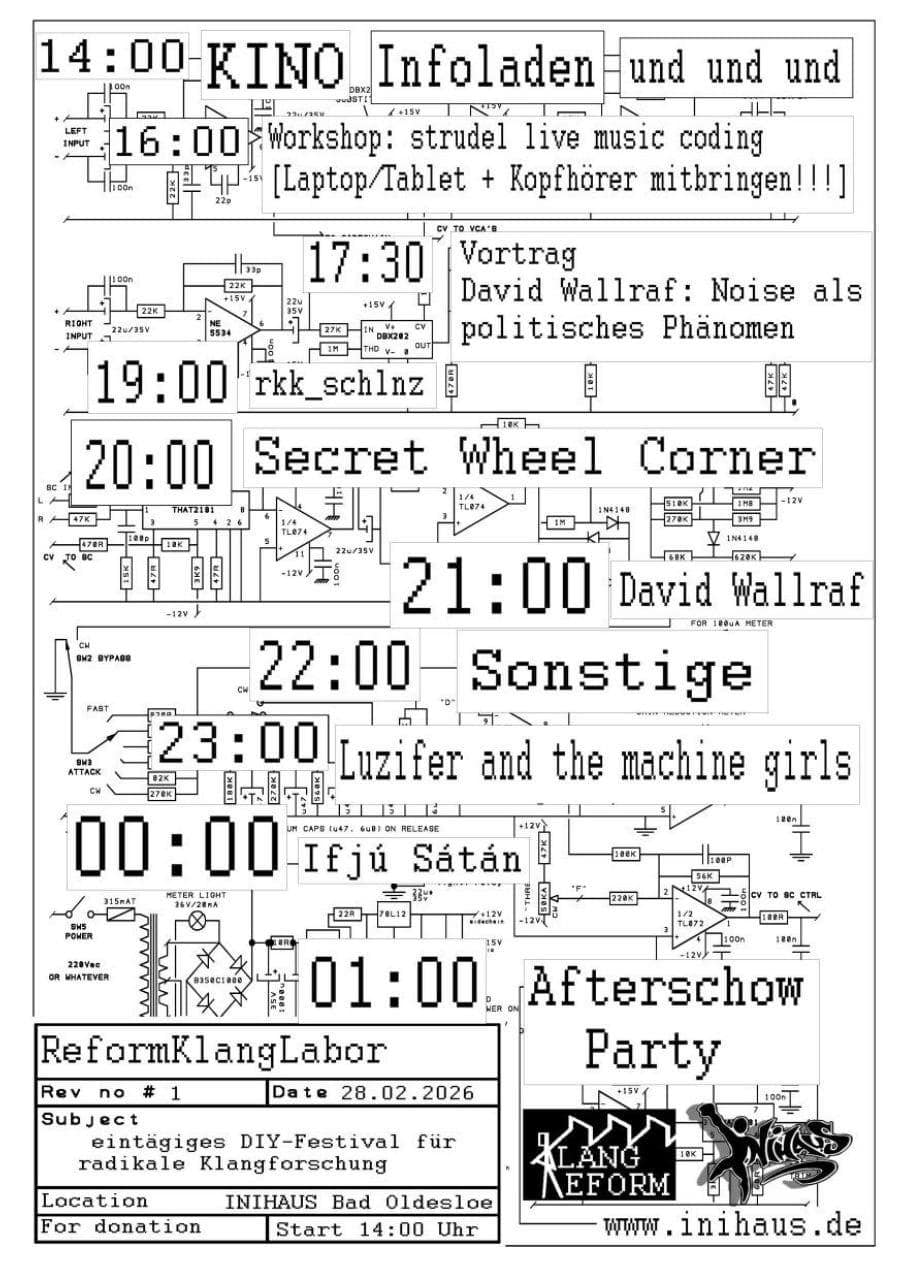
Will play at Inihaus in Bad Oldesloe end of this month at a charming noise festival with, among others, Luzifer And The Machine Girls. Will also do a presentation on noise and politics there.
Will play at Inihaus in Bad Oldesloe end of this month at a charming noise festival with, among others, Luzifer And The Machine Girls. Will also do a presentation on noise and politics there.
concert at hobbykeller festival #2
Schmitz und Kunzt, Richard Wagner Str. 8 Köln.
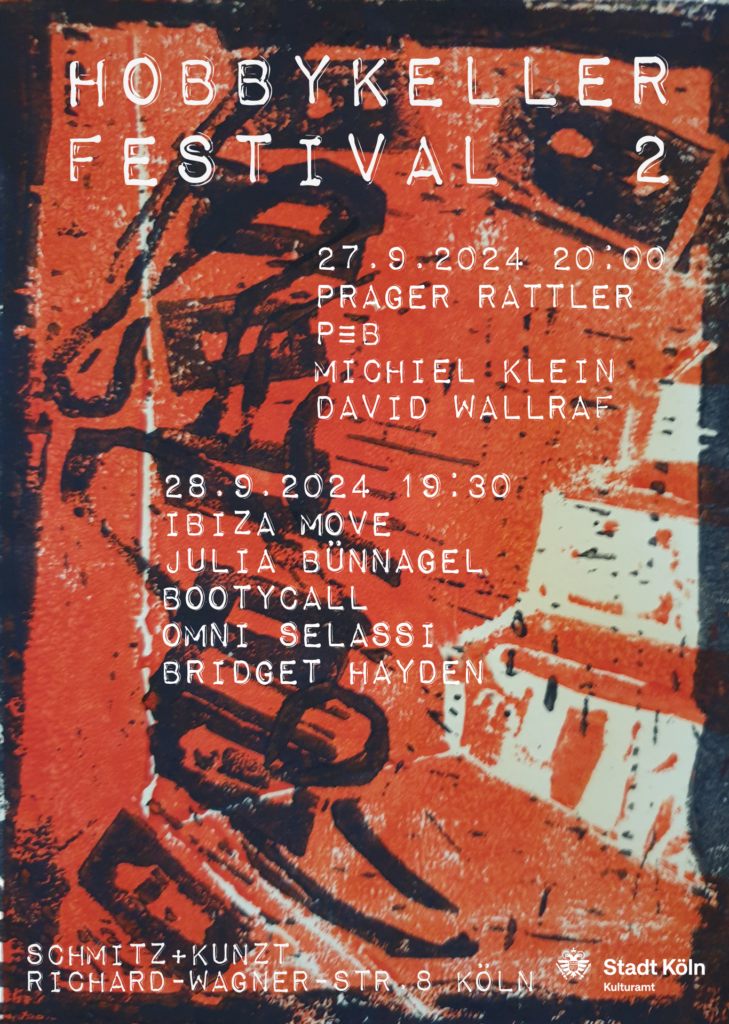
I will also do a lecture on noise, on saturday 28.09.24

On August 16 I’ll do a lecture and performance on The Commune of Nightmares at Kunstverein Leverkusen/Schloss Morsbroich.
Grenzen des Hörens – Noise | Sound | Silence. Vortrag und Konzert an der HKS Ottersberg.
I’m thrilled to announce that I’ll be participating in the ListeningBiennial in South East Asia in July.
In contrast to forms of cognitive capitalism, Yves Citton argues for attentional ecologies that can support and enhance sensate sovereignty across society. While cognitive capitalism instrumentalizes and individualizes attention, attentional ecologies nurture critical and creative capacities and related interdependent bonds. Ecologies of attention are fundamental to acknowledging and supporting mutuality and reciprocity; they do much to keep open what counts within the arenas of the sensible, reminding how “attention is our purest form of generosity” (Weil). The second edition of The Listening Biennial is envisaged as an ecology of attention, one shaped by a critical concern for challenging existing constructs of exclusion and extraction, and that invites a shift from paying to giving attention. Such giving is emphasized as profoundly dynamic, that moves across a range of sites and scenes, and whose movements incite and seed forms of recognition and cooperation, collective joy and contestation. This includes what we may term poetic sensing, where methods of engagement are enhanced by the power of the imagination. Following such perspectives, The Listening Biennial opens onto questions of sensate sovereignty and attentional ecologies, as well as imaginary power and the acts of storying that follow, and how these contribute to communal flourishing.
My schedule for the Bieannial:
July 12: Listening Tambayan at Fine Arts Gallery, University of the Philippines [annotated playlist as a sonic journey through different conceptions of noise and aural impossibilities. Noise becomes audible at and as the limits of sonic perception, as a technological artifact, the sound of silence and the turmoil of riots. Displaced and uncanny noises mix with sounds that are in themselves impossibilities, or unsound as Steve Goodman called them – from white noise and electromagnetic waves to birdsong and bats.]
July 14-16: Sound Camp at Alitaptap artist village [a workshop on sonic ecologies and bioacoustics in the Anthropocene, contrasting the writings on the soundscape by R.M. Schafer and Bernie Krause with McKenzie Warks work on the Anthropopcene. Sonic mapping of the geophony, biophony and anthropophony of the area surrounding Alitaptap]
July 22: Listening Symposium at Silpakorn University Bangkok [talk on Noise as Sonic Experience]
July 29: Listening Symposium at Malaysia Multimedia University Kuala Lumpur [talk on Noise as Sonic Experience]
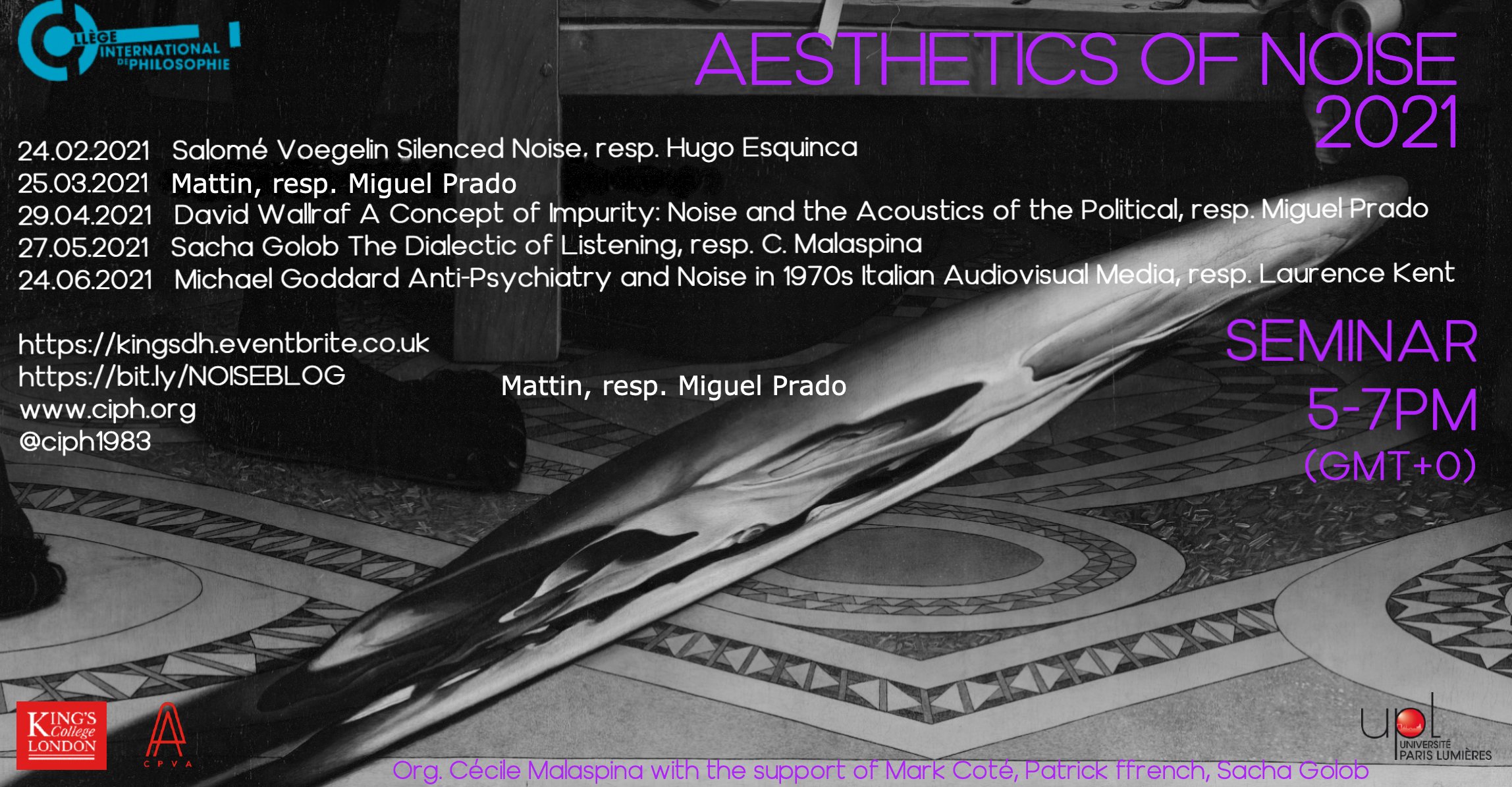
In this talk I want to argue for a concept of noise that is located between established theories using the term, be they acoustics, information theory or musicology. Noise should be understood as the difference between these conceptions, or as an ‘original impurity’. This will be demonstrated by the difficulty of translating noise to another language. In German it disintegrates into four terms: Lärm (loud or annoying sound, both a concept used in acoustics and a derogatory term in quotidian discourse), Geräusch (the opposite of musical or meaningful sound in musicology and linguistics), Rauschen (as in white noise, touching both on acoustics, physics in general and the concept of noise in information theory) and Störung (both in the sense of signal disturbance in information theory and of annoyance in everyday sonic environments). The noise-concept I am aiming for lies in the betweenness of these terms, an inter that shows itself in metaphors, blurring and a specific noisiness that – to a degree – affects all theories concerned with noise.
The consequences of this idea will be exemplified based by the acoustics of the political: ?what gets framed as noise in the context of political disagreement and what as a clear message How do acoustic and/or musical metaphors affect ideas of the political? In the context of protests, is it possible to draw lines between law, order and authority on one side and violence, chaos and noise on the other? What are the acoustics of the riot and on which side is noise to be found?
Thursday, April 29th, 5-7 pm GMT or 18:00 – 20:00 CET. Accessible via Microsoft Teams.
Radiophonische Vorlesung über Noise: ein Begriff, der die Grenzen seiner eigenen Definitionen sprengt und ein semantisches Rauschen in den Apparaten der begrifflichen Sprache freisetzt. Als Lärm, Geräusch, Rauschen und Störung durchquert er verschiedene Wissensgebiete, insistiert in ihren Zwischenräumen und zieht neue Verbindungslinien. In diesem Beitrag wird Noise als chaotisches Bindeglied zwischen Diskursen der Akustik, Philosophiegeschichte, Musikwissenschaft, Politik, Thermodynamik und Informationstheorie vorgestellt.
– – –
Ein Projekt des Online Musicking Call Mai / Juni 2020 des Verbands für aktuelle Musik Hamburg, gefördert von der Behörde für Kultur und Medien Hamburg.
– – –
[Radiophonic lecture on Noise: a term that breaks the boundaries of its own definitions and releases a semantic noise in the apparatuses of conceptual language. As hissing, sonic disturbance, entropy and acoustic violence it traverses different fields of knowledge, insists in their interstices and draws new connecting lines. In this feature, noise is presented as a chaotic link between discourses of acoustics, history of philosophy, musicology, politics, thermodynamics and information theory.]
Noise/Lesung/Diskussion 28.04.2017, 20.00, 10,-/5,- Euro
Veranstaltungsraum, Gaußstraße 60
Im August 2011 standen in London-Tottenham – wie in den Pariser Banlieus einige Jahre zuvor – ganze Straßenzüge in Flammen. Die Medien reagierten hier wie dort mit den Verdikten Mob und Pöbel zur Kennzeichnung derjenigen, die angesichts ihrer persönlichen Perspektivlosigkeit nur noch die Perspektive des Amoks entwickeln konnten, um ihrer Lage Ausdruck zu verleihen. Dem ausgegrenzten Teil der Stadt, der dunklen Seite der Urbanität wird sich in dieser Veranstaltung durch eine Mischung von Lesung und experimenteller Musik angenähert.
Lesung/Diskussion: Karl Heinz Dellwo – „Wenn die Toten erwachen – Die Riots in England 2011“http://www.laika-verlag.de/laika-diskurs/wenn-die-toten-erwachen
Konzerte: Helge Meyer https://soundcloud.com/helgemeyer
RLW / PAAK https://soundcloud.com/paak-2
David Wallraf https://soundcloud.com/david-wallraf
lecture on the 2011 london riots by karl heinz dellwo,
noise by helge meyer & me.
Atelierhaus23, Am Veringhof 23, 21207 Hamburg
20.00, 5,- euro
27.01., 21.00, Druckerei im Gängeviertel – Niemand hat die Absicht –
Maginot (Harsh Noise)
https://vimeo.com/82449371
David Wallraf (No Noise)
https://soundcloud.com/david-wallraf
Helge Meyer (Free Noise)
https://vimeo.com/193650136
Best Friend Machine (BFF Noise)
https://soundcloud.com/best-friend-machine
Brenz Hold (DJ-Set)
https://soundcloud.com/brenz-hold-1
Difficult Music (DJ-Set/FSK Hamburg)
www.mixcloud.com/difficultmusic
29.01., 20.30, Golem
Lecture: „The Rapturous Dead End of Noise“
Concert by Vomir
Der irische Performer, Autor und Wissenschaftler Paul Hegarty wird in seinem Vortrag „The Rapturous Dead End of Noise“ das komplexe Verhältnis von Noise, Performance und Kommunikation anhand der konkreten Beispiele von Harsh Noise und Harsh Noise Wall befragen. Hegarty ist Betreiber des Labels „dotdotdotmusic“ und veröffentlichte mit seinem 2007 erschienenen Buch „Noise/Music – A History“ eine der ersten philosophischen Auseinandersetzungen mit diesem Thema. Weitere seiner Publikationen sind „Rumour and Radiation – Sound in Video Art“ und der Reader „Reverberations – The Philosophy, Aesthetics and Politics of Noise“. Der Vortrag beginnt mit einer Einleitung von David Wallraf und schließt mit einem Konzert von Romain Perrot alias Vomir.
http://www.vamh.de/index.php?gig=3162
 ⠙⠁⠧⠊⠙ ⠺⠁⠇⠇⠗⠁⠋